In the name of Allāh, ar-Raḥmān (the most merciful), ar-Raḥīm (the bestower of mercy).
All praise is for Allāh, who sent his Messenger to guide humanity from darkness into the light of Islām. May salutations of praise and peace be upon our beloved Prophet, his wives, family and Companions.
In this brief article, I have provided basic details about the life of the noble Prophet of Islām, which every Muslim should be familiar with, as well as a reference for ourselves and when teaching our families and children.
What was his name?
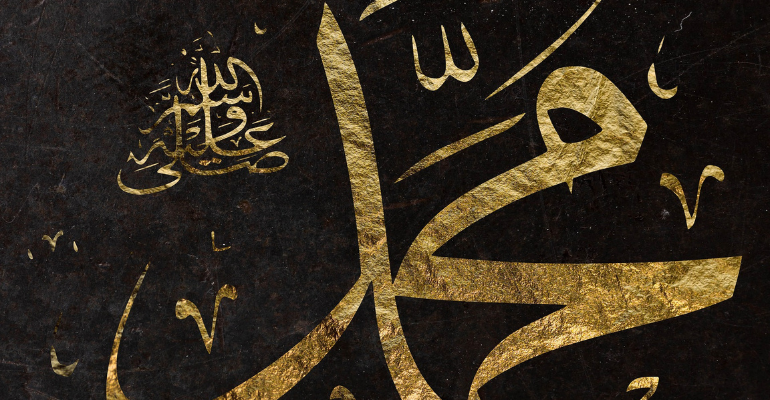
He is Muḥammad, the son of ‘Abdullah.
What was his lineage?
Muḥammad, the son of ‘Abdullāh, the son of ‘AbdulMuṭṭalib, the son of Hāshim. Hāshim was from the tribe of Quraysh. The Quraysh are from the Arabs, who are the descendants of Prophet Ismā’īl, the son of Prophet ‘Ibrāhīm (may peace be upon all the Prophets).
Who were his parents?
His father was ‘Abdullāh Ibn ‘AbdulMuṭṭalib; he died before the birth of the Prophet (peace be upon him). His mother was Āminah bint Wahb; she died when the Prophet was only 6 years old.
So the Prophet (peace be upon him) was born and grew up as an orphan, without a father or a mother.
When was he born?
The exact day and month of the Prophet’s birth are disputed among the scholars, though there is broad agreement that he was born in the “Year of the Elephant”. This was approximately 570 of the Christian era, i.e. approximately 570 years after the birth of Jesus according to the common Christian calendar.
The Year of the Elephant relates to a year in history wherein a great army from Abyssinia, with elephants, came to conquer Makkah.
Where was he born?
He was born in the sacred city of Makkah, in present-day Saudi Arabia.
Where did he migrate to, and where did he die?
Due to persecution, he and his followers left Makkah and moved to the city of Madinah, where he lived for the remainder of his life and eventually died.
Upon arriving in the vicinity of Madinah, one of the first acts of the Prophet ﷺ was to establish a Masjid. He first built the Mosque of Qubāʾ and later oversaw the construction of his Mosque in Madinah before building his own living quarters.
Did he have any brothers and sisters?
He did not have any biological brothers or sisters. However, he had foster brothers and sisters who were related to him through having the same suckling mother(s).
They include:
Foster brothers:
- Abu Salamah Abdullāh Ibn ‘AbdulAsad.
- Ḥamzah ibn ‘AbdulMuṭṭalib.
- ‘Abdullāh Ibn al-Ḥārith.
Foster Sisters:
- Shaimā bint al-Ḥārith.
- Unaysah bint al-Ḥārith.
Who were his wives, and why did he marry them?
His wives are called Ummuhāt al-Mu’minīn (Mothers of the Believers). They are:
- Khadījah bint al-Khuwaylid: He married her when he was 25 years old and she was 40 years old. She bore all his children except one son. He did not marry any other woman whilst being married to her.
- Sawda bint Zam’ā: She was a widow and the mother of five children. Her friend called Khawlah bint Ḥakīm, was concerned for both her and the Prophet ﷺ, who had recently lost Khadījah, so she approached the Prophet ﷺ, encouraging him to marry Sawdā. He married her when he was 50 years old.
- ‘Āisha bint Abi Bakr as-Ṣiddīq: She was the only virgin he married; she was the daughter of his best friend. She grew up to be a great scholar, teacher and authority of knowledge in Islām.
- Ḥafṣah bint ‘Umar: She was a widow whose husband was martyred in the battle of Uḥud. After the death of her husband, her father, Umar ibn al-Khaṭṭāb, searched for an appropriate man to marry her. They were overjoyed when the Prophet ﷺ accepted the proposal.
- Zaynab bint Khuzaymah al-Hilāliyyah: She was known as Umm al-Masākīn (the Mother of the Poor) due to her care and concern for the poor, needy and orphans. She was a widow whose husband died in the battle of Badr. The Prophet ﷺ married her when he was 56 years old. He married her out of concern for her welfare and to take care of her after the death of her husband.
- Umm Salamah: She was one of the earliest people to accept Islām along with her husband. They both migrated to Abyssinia, then Madinah. In Madinah, her husband died, leaving her behind with 4 children. The Prophet ﷺ married her after she had been widowed and left with several children.
- Zaynab bint Jaḥsh: She was a cousin of the Prophet ﷺ. She was married to the Prophet’s adopted son, a freed slave called Zayd. This marriage – between Zaynab and Zayd – was encouraged by the Prophet ﷺ himself, as a way to break social class barriers; she was from a noble Qurayshi family, while Zayd had been a slave. However, the marriage did not last, and they eventually divorced. Before Islām, the custom of the Arabs was that an adopted son was taken in as a biological son. However, Islām abolished the practice of treating an adopted child as though he were a biological child while preserving the obligation of kindness, care and support for adopted children. After the divorce between Zaynab and Zayd, Allah commanded the Prophet ﷺ to marry her. This demonstrated in practice that an adopted son does not have the same legal status as a biological son.
- Juwairiyyah bint al-Ḥārith: She was a noble woman who was taken captive during a war. She came to the Prophet ﷺ complaining of her situation and asking the Prophet to help her to free herself by paying her ransom. He offered to pay it on her behalf and then married her. As a result of this marriage, the companions freed over 100 captives from her tribe, saying, “These people are now relatives of the Prophet ﷺ.” This marriage became a cause of immense blessing for her people.
- Ṣafiyyah bint Ḥuyayy: She was a non-Arab woman of Jewish descent who had been taken captive after the Battle of Khaybar. The Prophet ﷺ freed her and invited her to accept Islām. Upon accepting Islām, the Prophet ﷺ married her. His marriage to an ex-Jewish non-Arab woman also broke social and tribal barriers, sending a powerful message that piety and righteousness are more important than ethnicity, colour or race.
- Umm Ḥabība Ramlah: She migrated to Abyssinia along with her husband, who had accepted Islām. However, her husband then reverted to disbelief and died whilst drinking alcohol. He left her behind alone, with a young child, in a foreign country. The Prophet ﷺ heard of her plight, the Negus of Abyssinia arranged her marriage to the Prophet ﷺ and sent her to Madinah.
- Maymūnah bint al-Ḥārith: She was the last wife of the Prophet ﷺ. She had been widowed before her marriage to the Prophet.
Most of the Prophet’s marriages took place after the age of fifty. With the exception of ‘Ā’ishah, all of his wives were previously married, and many were widows.
Did he have any children?
All the sons of the Prophet ﷺ died in their infancy. They are:
- Qāsim.
- ‘Abdullah.
- Ibrāhīm.
His daughters lived during his lifetime:
- Zaynab: She was the eldest daughter of the Prophet ﷺ, born ten years before Prophethood, i.e. when the Prophet was 30 years old. Her husband initially refused to accept Islām, thereby delaying her migration to Madinah. He was captured whilst fighting the Muslims in a battle and held captive. His wife Zaynab sent a necklace as his ransom, and he was freed by the Muslims with the understanding that he would allow his wife to migrate to Madinah. Upon his return to Makkah, he fulfilled his promise and the Prophet’s daughter Zaynab was reunited with her father. A few years later, her husband accepted Islām, and migrated to Madinah, once again reunited with his wife. Zaynab passed away during the lifetime of the Prophet; she was 31 years old.
- Ruqayyah: She was three years younger than her sister Zaynab. She was married to ‘Uthmān ibn ‘Affān after being divorced by her husband due to her accepting Islām. She migrated to Madinah but died very early on, during the Battle of Badr. She was only 22 years old.
- Umm Kulthūm: She was born 6 years before the Prophethood, i.e. when the Prophet ﷺ was 34 years old. After the passing of her sister Ruqayyah, she married Uthmān Ibn ‘Affān. Umm Kulthūm died a year before the Prophet’s ﷺ own passing – when he was 62 years old.
- Fāṭimah: She was his youngest daughter; she was born 5 years before his Prophethood, i.e. when he was 35 years old. She married the Prophet’s cousin – ‘Ali ibn Abi Ṭālib and together, they had several children, including Ḥasan and Ḥusayn. She passed away six months after the death of the Prophet ﷺ; she was only 29 years old.
What type of house did he live in? What was his lifestyle?
- In his ten years as the ruler of Madinah, the leader of a growing nation, the commander of an army, the Prophet had access to considerable wealth and power, yet never lived in luxury. Rather, he lived in small living quarters known as “Ḥujarāt”. Each wife had a modest room, only a few metres across, constructed from mud bricks and palm branches, with a low ceiling. The doors of these rooms opened directly into the Prophet’s Mosque. He would sleep on the floor, on a straw mat.
- Even after the Arabic Peninsula recognised his authority, and many tribes pledged their allegiance to him, he never lived like a king or emperor. He never used to allow people to stand up for him when entering a room, nor remain standing over him while he was seated. Often, he could not be distinguished from the rest of his companions. If a stranger walked in upon the Prophet and his companions, he would need to ask: ‘Who amongst you is Muḥammad, the Messenger of Allāh?’
- He treated all people fairly and justly. He never gave preferential treatment to the rich, and he never overlooked the rights of the weak and poor. He preferred the companionship of the poor, weak and freed slaves. He said, “Seek me among your weak, for you are only given provision and victory through your weak ones.” [at-Tirmidhī]
- His clothing, shoes, lifestyle, accommodation and food were no better than most of his companions, and often even simpler than theirs – may peace and blessings be upon him.
What was his message?
His mission was the same as every other Prophet and Messenger. He was sent as a bearer of glad tidings, a warning and as a witness.
Allāh said about him:
{O Prophet, indeed We have sent you as a witness, a bringer of good tidings and a warner} [33:45]
He called to the worship of Allāh, that mankind should be sincere and truthful to their Creator. He urged the people to appreciate the many blessings of their Lord and to show gratitude to him through their worship of him. He warned against turning away from Allāh and associating partners with him.
He reminded people of their Creator, and he then taught them how to worship him, as well as the manners and morals we should adopt towards creation.
He was a witness over all of mankind that the message of Allāh has been conveyed to all.
He said about his message,
“Indeed, I have only been sent to perfect the noble manners”.
Allāh said about him:
{We did not send you except as a mercy to creation} [21:107]
Prophet Muhammad ﷺ did not claim to bring a new religion. Rather, he taught that he was the final Messenger in the same line of Prophets that included Adam, Noah, Abraham, Moses and Jesus – peace be upon them all. His message was to return mankind to the pure worship of the one creator, without intermediaries, partners or rivals.
What were the struggles he went through?
- The Prophet ﷺ was born without a father, and his mother died young; so he grew up as an orphan. He was then placed in the care of his grandfather, AbdulMuṭṭalib, who also died whilst the Prophet was young. Finally, he was placed under the care of his uncle Abu Ṭālib.
- Both his uncle Abu Ṭālib and his beloved wife Khadījah, died in the same year – the 10th year of his Prophethood. All his children passed away during his lifetime, apart from his youngest daughter, Fātimah, who died 6 months after his death.
- The Quraysh also harmed him through mockery, nicknames and lies, as well as physical harm. They plotted to assassinate him just before he migrated from Makkah to Madinah, and then chased him during his journey to Madinah to kill him.
- To harm him, the Quraysh would torture his companions and kill some of them. The Prophet ﷺ could not do anything to prevent this in Makkah.
- When he finally reached Madinah, his struggles did not cease. The hypocrites within Madinah and various Jewish tribes would undermine him and plot against him. They poisoned his food, attempted to assassinate him by dropping a boulder upon him, broke treaties and repeatedly plotted against him.
- Whilst living in Madinah, he never filled his stomach for more than two nights consecutively; most of his diet consisted of dates, water and bread. Many weeks would pass, and a fire would not be lit in his house to cook. Meat, milk, vegetables and fruits were a rare luxury, as opposed to a staple.
- There were times when hunger became so severe that he would tie a stone to his stomach.
How did he deal with these struggles, difficulties and persecution?
- Despite all these struggles, the Prophet ﷺ remained patient upon the harms of the people and the distress of life and poverty; he had no attachment to the luxuries of this worldly life, and he never forgot his past. For this reason, he would give special consideration and care to the orphans – because he grew up as an orphan.
- He was gentle, approachable and broad-hearted in his dealings with people; content with the decree of Allāh and optimistic; courageous in speaking the truth and not fearing the blame of people. He never sought revenge for himself; in fact, his pleasure and anger were only for the sake of Allāh, and he did not allow his personal interests to interfere with this.
- He maintained a cheerful disposition, always smiling in front of the people, being playful with children, caring towards the sick and respectful towards elders. He would advise women and advocate for the rights of the poor and the slaves. He would follow the funeral procession and often ask about a companion if he was absent.
- He remained focused and steadfast upon his mission and the reward of the Hereafter, and his worldly struggles did not deter him. He did not care much for the luxuries of the world; he never allowed them to distract him from his responsibility of guiding the people.
When did he die, and how many years did he live?
The Prophet ﷺ lived for 63 years, 40 years before Prophethood and then 23 years as a Prophet and Messenger. Of these 23 years, he lived 13 in Makkah and 10 in Madinah, where he died. He died in 632 CE.
Why is Prophet Muhammad important today?
He died over 1400 years ago, yet remains just as relevant to both Muslims and non-Muslims. Muslims believe him to be the final Prophet sent to mankind. Through him, the Qur’ān was revealed, and through his teachings, Muslims learn how to worship their Creator and live their lives.
He is also relevant to non-Muslims, as more than two billion people follow his message and look to him as their example. He taught belief in and respect for all of God’s Prophets, including many of those revered by Jews and Christians, such as Noah, Abraham, Moses and Jesus (peace be upon them all), as well as the scriptures revealed to them. Understanding his life is therefore important for anyone wishing to understand Islam and one of the most influential individuals in human history.
May peace and blessings be upon the Prophet of Islām, his family, his Companions and all those who follow his guidance.
May Allāh reward him on our behalf with the best reward given to any Prophet on behalf of his nation.
Written by the one in need of Allāh:
Abul Abbaas Naveed Ayaaz,
Nelson, Lancashire, UK
27th Rabee’ al-Awwal, 1436h
18th January, 2015